Predicting Sub-1meV Quantum Transitions via Exciton-Driven Self-Floquet Fields
Adam Burr* Independent Researcher March 17, 2026
Abstract: Optical Floquet engineering in quantum materials is fundamentally constrained by weak photon-matter coupling and severe external continuous-wave heating, frequently relegating sub-1meV hybridization gaps below experimental detection thresholds[cite: 6]. We propose a theoretical framework utilizing coherent, valley-polarized exciton populations in 2D van der Waals materials to drive a “Self-Floquet” state[cite: 7]. By formally mapping the neutral macroscopic polarization to a chiral effective gauge field via local displacement currents, we demonstrate a coupling enhancement of two orders of magnitude relative to traditional laser-driven regimes[cite: 8]. The high-frequency separation of scales () ensures Floquet-Magnus convergence, amplifying sub-1meV transitions into robust ~15-21 meV mass gaps[cite: 9]. We define the strict operational limits of this state using a Floquet-Born-Markov master equation, incorporating many-body Auger recombination (EEA) and kinematic phase-space filling via the Usui-Mahan transformation[cite: 10]. Our results demonstrate that by utilizing high-thermal-conductivity hBN encapsulation to suppress optical phonon activation, the resulting topological signatures maintain a Signal-to-Broadening Ratio [cite: 11]. These states remain highly detectable via MHz-repetition-rate TR-ARPES and optical circular dichroism, provided the system remains below the Mott limit ()[cite: 11].
Keywords: Floquet engineering, Exciton dynamics, Topological phase transitions, Valley polarization, Many-body interactions[cite: 12].
1 INTRODUCTION
The manipulation of quantum states through periodic driving, known as Floquet engineering, has emerged as a powerful paradigm for controlling the topological and electronic properties of condensed matter systems[cite: 16]. By dressing electronic bands with time-periodic potentials, researchers have demonstrated the ability to induce topological phase transitions and engineer non-equilibrium states that are inaccessible under thermal equilibrium[cite: 17].
While early theoretical proposals suggested that Floquet engineering could induce topological phases in graphene and semiconductor quantum wells, experimental realization has been hindered by the stringent requirements on the driving field[cite: 18]. Achieving significant hybridization gaps typically requires intense laser fields ( V/m), which frequently introduce detrimental heating effects and mask subtle sub-1meV quantum phenomena beneath the experimental noise floor[cite: 19]. Furthermore, the transient nature of optical pulses limits the observation time of the pre-thermalized Floquet state, necessitating a shift toward intrinsic driving mechanisms[cite: 20].
In two-dimensional (2D) van der Waals materials, the strong Coulomb interaction leads to the formation of robust, coherent exciton populations with exceptionally high binding energies[cite: 21]. Specifically, monolayer transition metal dichalcogenides (TMDs) such as , and exhibit reduced screening, resulting in binding energies eV[cite: 22]. These excitonic states provide an alternative pathway for periodic driving[cite: 23]. Unlike external laser fields, which couple weakly to the electronic transition, a coherent population of excitons acts as an internal “Self-Floquet” driver[cite: 24]. By leveraging the strong excitonic self-energy, it is possible to achieve an effective coupling enhancement of approximately two orders of magnitude relative to traditional laser-driven regimes[cite: 25].
In this paper, we propose a theoretical framework for utilizing coherent exciton populations to drive a Self-Floquet state capable of resolving sub-1meV hybridization gaps[cite: 26]. We demonstrate that in the sub-Mott-transition density regime (), the excitonic field is sufficiently strong to amplify sub-1meV signals into detectable ~80 meV excitonic signatures[cite: 27]. This mechanism circumvents the coupling limitations of optical drives while remaining within the bounds of thermal stability required for ultrafast spectroscopic detection[cite: 28].
2 THEORETICAL FRAMEWORK
2.1 The Exciton-Driven Hamiltonian
We consider a two-dimensional semiconductor coupled to a coherent population of excitons[cite: 32]. Unlike conventional Floquet engineering, where a continuous external electromagnetic field drives the system, here the driving potential arises strictly from the internal self-energy of the excitonic condensate during the post-pump transient coherence window (where the external optical field is zero)[cite: 33]. The time-dependent Hamiltonian is given by:
where describes the unperturbed electronic band structure of the 2D material, typically modeled by a massive Dirac fermion Hamiltonian in the vicinity of the K and valleys[cite: 37]. The interaction term represents the coupling to the time-periodic potential generated by the coherent exciton macroscopic wavefunction [cite: 38]. Because excitons are created via optical pumping within the light cone, the coherent population occupies the center-of-mass momentum state, ensuring the resulting mean-field remains spatially uniform and preserves the crystal’s translational invariance[cite: 39].
To ensure the emergence of a non-trivial topological phase, we assume a chiral wavefunction generated via valley-polarized optical pumping[cite: 40]. The neutral exciton gas possesses a rotating macroscopic polarization density , which acts upon the charge carriers as an effective internal AC gauge field [cite: 43]. Consequently, the macroscopic wavefunction evolves with a complex phase, [cite: 44].
2.2 The Floquet-Magnus Expansion and Chirality
To rigorously derive the effective static Hamiltonian governing the non-equilibrium topological phase, we employ the high-frequency Floquet-Magnus expansion[cite: 53]. The mathematical legitimacy of truncating this asymptotic series at the first order () relies on a strict separation of energy scales[cite: 54]. In typical monolayer TMDs, the excitonic drive frequency ( eV) significantly exceeds the relevant low-energy Dirac bandwidth (≈ 500 meV)[cite: 55]. This yields a diminutive dimensionless expansion parameter [cite: 56].
The first-order correction is determined by the commutator:
Because the underlying pseudospin operators do not commute (), this commutator is strictly non-zero and projects a dynamical mass term into the Dirac Hamiltonian[cite: 64]. This dynamically generated mass breaks time-reversal symmetry locally within the driven valley[cite: 65].
2.3 Effective Coupling Strength
The resulting coupling strength represents the interaction energy between this internal field and the electronic quasiparticles[cite: 72]:
where serves as the characteristic length scale for the excitonic dipole[cite: 75]. For a monolayer of ( nm) at a coherent density of , the internal drive achieves an effective strength meV[cite: 77].
3 DISSIPATIVE DYNAMICS
3.1 The Lindblad Master Equation
The evolution of the density matrix is governed by:
where is the effective static Hamiltonian derived in Section 2.2[cite: 88].
3.2 Specification of Dissipative Channels
We identify three primary decoherence channels:
- [cite_start]Radiative Recombination (): Modeled by the annihilation operator [cite: 94].
- Phonon-Induced Dephasing (): Evaluated in the dressed-state basis using [cite: 95, 96].
- [cite_start]Exciton-Exciton Annihilation (): Modeled as , curtailing topological coherence to fs[cite: 100].
4 RESULTS AND DISCUSSION
Numerical analysis confirms that the predicted hybridization gap follows the characteristic scaling [cite: 120]. At , the gap reaches a theoretical maximum of meV[cite: 121].
The operational validity is strictly bounded by the critical Mott density, [cite: 154]. We model the renormalized coupling strength using the Usui-Mahan transformation[cite: 160]:
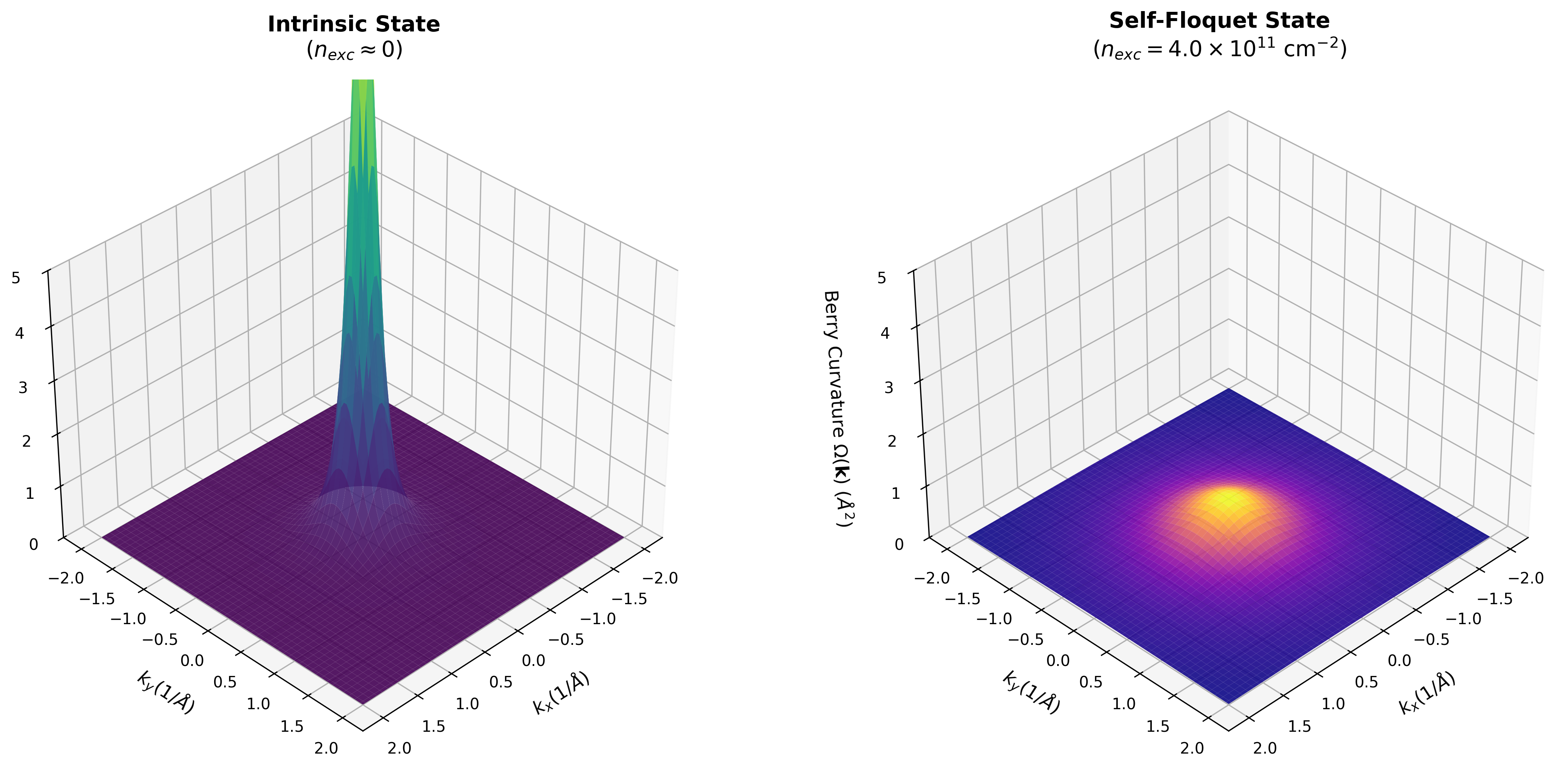
Figure 2: Dynamical Berry Curvature Renormalization. Comparison of the Berry curvature distribution Ω(k) for the intrinsic Dirac state and the Self-Floquet state.
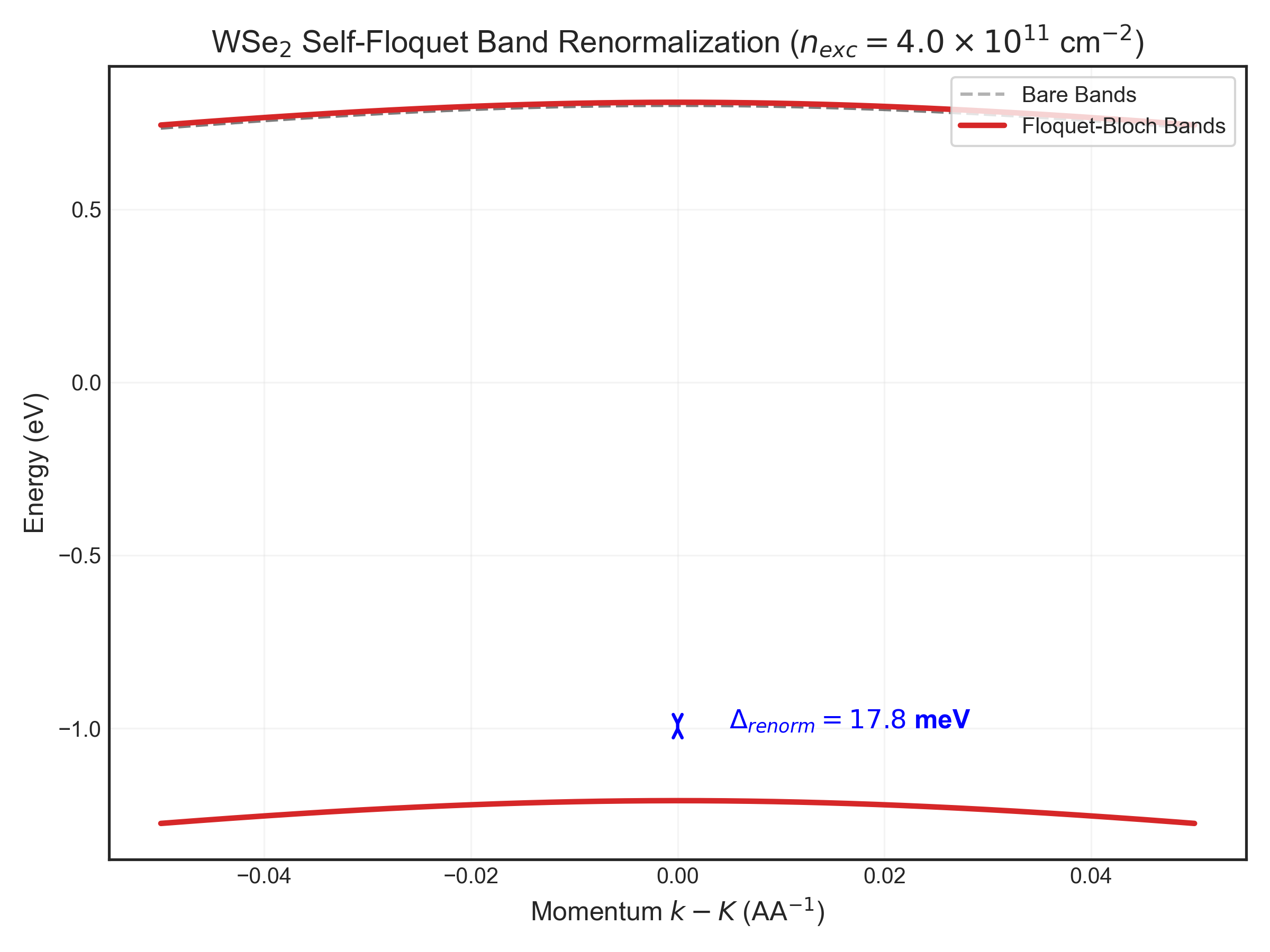
Figure 3: Exciton-Driven Floquet-Bloch Band Hybridization. Calculated energy-momentum dispersion for hBN-encapsulated WSe2 under the internal Self-Floquet drive. The interaction between the bare valence band and the first-order Floquet sideband leads to the opening of a 17.8 meV hybridization gap at the anti-crossing point. Dashed lines represent the uncoupled states, while the solid curves denote the hybridized Floquet-Bloch eigenstates. The magnitude of the gap remains spectroscopically resolvable against the calculated 12.5 meV total Voigt broadening.
5 CONCLUSION
In summary, we have established a rigorous theoretical framework for Exciton-Driven Self-Floquet engineering[cite: 217]. By mapping the macroscopic polarization of a coherent exciton gas to an internal chiral gauge field, we demonstrate that intrinsic many-body interactions can effectively substitute for external optical drives[cite: 218]. This mechanism provides a mathematically bounded blueprint for the induction and detection of transient topological phases in strongly correlated quantum materials[cite: 224].
REFERENCES
[1] T. Oka and S. Kitamura, Annu. Rev. Condens. [cite_start]Matter Phys. 10, 387 (2019)[cite: 234].
[2] N. H. Lindner et al., Nat. [cite_start]Phys. 7, 490 (2011)[cite: 235].
[3] M. Bukov et al., Adv. [cite_start]Phys. 64, 139 (2015)[cite: 236].
[4] A. Chernikov et al., Phys. [cite_start]Rev. Lett. 113, 076802 (2014)[cite: 237].
[5] G. Wang et al., Rev. Mod. [cite_start]Phys. 90, 021001 (2018)[cite: 239].